
What Are the Continuing Education Requirements for Michigan Insurance Agents?

24 Credits, 3 Ethics, One Package
Everything Michigan asks for, organized so nothing posts short.
Quick Answer
- 24 credits every two years, and 3 of them must be ethics. The other 21 can be in any approved subject, including lines of authority you do not hold.
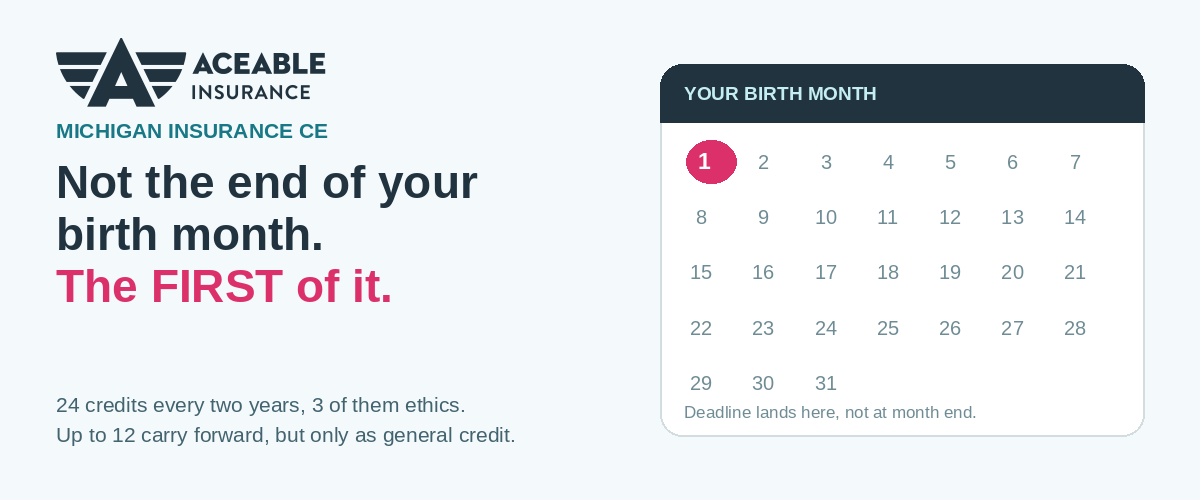
- Your deadline is a review date, not a renewal date. It falls on the first day of your birth month, which is a full month earlier than agents coming from neighboring states expect.
- Completion is not compliance. Credits have to be reported and posted to your DIFS record before the review date, and a certificate in your inbox proves nothing to the state.
Michigan producer licenses are perpetual, so you don't need to file a renewal application or watch for an expiration date. Instead, the Michigan Department of Insurance and Financial Services (DIFS) runs everything off a CE review date tied to your birth month and birth year. Meet the 24 credits by that date, and nothing happens, which is exactly what you want. Miss it, and the license is suspended for education the same day.
When Is Your Michigan CE Review Date?
This detail trips up agents who transferred in from another state. Most states set the deadline at the end of the birth month. Michigan sets it at the beginning. If you are used to having the whole month, you just lost thirty days.
The Odd and Even Year Rule
Your review year is determined by your birth year. If you were born in an odd-numbered year, your CE is due in odd-numbered years. If you were born in an even-numbered year, it is due in even-numbered years. Successive review dates come every two years after that.
Where to Find It on Your License
Your first CE review date is printed on your license document in the lower left corner. You can also verify it, along with your current credit count, through the DIFS Insurance Agent Locator. Checking the locator rather than trusting memory is the single cheapest compliance habit in this state.
Why Your First Review Date May Be Further Out Than You Think
Here is a rule almost no provider page mentions. Your first review date has to give you at least twelve months to complete 24 credits after your license is approved. If the next date matching your birth month and year parity falls sooner than that, DIFS pushes your first review date out by two full years instead.
So a producer licensed in the summer whose birth month arrives a few months later does not owe 24 credits in those few months. Their clock starts on the following cycle. New licensees who assume the worst often buy hours they did not need yet. Check the locator before you buy anything. If you are still working through licensing, our guide to Michigan pre-licensingPre License What Are The Pre Licensing Education Requirements For A Michigan Insurance License Resources covers the education that comes first.
What Do the 24 Credits Have to Include?
Three credits of ethics, every single period. This is a floor, not a target. If you complete more than three ethics credits, the extra ones do not count as ethics. They roll into your general total.
Twenty-one general credits in any approved subject. Michigan does not require your coursework to match the lines you hold. A property and casualty producer can take life credits and get full value. That flexibility is unusual, and it is worth using, because it lets you study something you might actually sell next year instead of rereading material you already know.
Any approved delivery format. Classroom, webinar, and self-study online courses all count. One caveat worth knowing before you buy: Michigan requires self-study course exams to be monitored by a disinterested third party, meaning someone with no financial stake in whether you keep your license. Confirm how a provider handles that step before you enroll.
Separate product training where it applies. Producers who sell annuities must complete a one-time annuity best interest training course before they can transact annuity business. Long-term care producers carry their own initial and ongoing training. Flood producers writing federally backed policies have a separate course as well. These sit alongside your 24 credits rather than replacing them.
How Does CE Carryover Work in Michigan?
Michigan allows carryover, with two conditions that agents routinely get wrong.
You have to be compliant first. Carryover is calculated only after the current period's minimum is satisfied: all 24 credits, including the 3 ethics. You cannot bank hours toward a period you have not finished.
The maximum is 12 credits, and they arrive as general credit. Excess ethics credits carry forward too, but they convert to general hours on the way. That means banked hours can never cover next period's ethics requirement. Three fresh ethics credits are due every review period, no matter how far ahead you got.
Practically, carryover rewards the agent who finishes early and keeps going, and it does nothing at all for the agent who is scrambling. Half your next cycle can be done before it starts.
Why Do Duplicate Courses Post With Zero Credit?
DIFS will not count the same course twice inside one review period. The record shows the completion with zero credit attached, which is a quiet failure mode: the course appears on your transcript, so it looks like progress until you count the credits.
The definition is broader than most agents assume. A duplicate is a course with the same name or one containing the same material as a course you already completed. Two different providers selling the same underlying ethics module can trigger it. So can a bundle that overlaps with something you took eight months earlier.
This is the most common reason a producer who believed they finished comes up three credits short in the final week. Pull your credit list before buying a second package, not after.
Who Does Not Need Michigan CE?
- Limited line licensees. Limited Life, Turkey, Crop and Hail, Travel, Accident and Baggage, Title, Credit Products, and Limited Lines Property and Casualty carry no CE requirement.
- Nonresident producers. Michigan is reciprocal with every other state. Satisfy your home state and you automatically comply here, with nothing to submit to DIFS. Our breakdown of Michigan reciprocityPre License How Does Insurance License Reciprocity Work For Michigan Agents Resources covers how that works across multiple licenses.
- Severe hardship waivers. DIFS may grant a waiver or extension for terminal illness, an illness of you or your spouse requiring extensive care, or active military duty. The request must be a written letter filed before your deadline, with supporting documentation such as a physician's statement or deployment orders.
Everyone else owes the full 24. Holding more lines of authority does not increase the requirement, and holding fewer does not reduce it.
Choose a State and Course
Why Is Completion Not the Same as Compliance?
You are not compliant until the credits are posted to your DIFS record. Finishing a course, passing the exam, and receiving a certificate are all steps toward compliance rather than proof of it.
Providers are required to submit credits electronically to DIFS within 30 days of completion and to pay a $1.00 per credit hour reporting fee when they do. You are responsible for supplying your seven digit System ID number at registration and for covering that reporting fee, which providers collect either at signup or at completion.
Two things follow from that. First, a wrong or missing license number means your hours land nowhere, and you will not find out from anyone but yourself. Second, national designation programs often do not report Michigan hours automatically. Many charge a separate fee to report on your behalf. Ask before you enroll, not after.
What Can Slow Down Your Michigan CE Cycle?
- Reading the review date as end of month. It is the first day of your birth month, so an agent working to the end of the month is already a month late.
- Duplicate material you did not recognize. Same-content courses from two providers post at zero credit and leave a gap you discover too late to fix.
- Assuming banked ethics carries. Extra ethics credits convert to general on carryover, so the 3 ethics credits come due again every period.
- A missing or mistyped System ID. Credits reported against the wrong number never reach your record, and the certificate in your file will not fix it.
- An outdated address on file. DIFS sends CE warnings and status notices to the contact information it has, and failing to keep it current carries its own penalties.
How Does Michigan Compare to Other States?
The 24-hour biennial requirement with 3 ethics credits is the most common structure in the country. North Carolina, Ohio, Oklahoma and Louisiana all run the same totals, so an agent licensed across the Midwest and Southeast is usually solving the same arithmetic in several places at once. States that tier by lines of authority, like New York CE, are the exception rather than the rule.
Where Michigan genuinely differs is the timing and the consequence. The first-of-the-birth-month review date is earlier than most states, and the penalty is not a fine. A missed review date suspends the license for education, during which you can service existing business but cannot write anything new. Michigan is also more generous than average on subject matter, since courses in any line of authority count toward your general credits.
Current requirements, the agent locator, and the approved provider list are published by DIFS.
How Do You Plan a Clean Review Period?
The agents who never think about CE run the same short playbook. They look up the review date on the locator the week a new period opens, rather than hunting for it later. They finish ethics first, because it is the one category carryover can never cover. They buy in one package from one provider to eliminate duplicate risk. And they target completion 60 days out so the 30-day reporting window closes well before the deadline.
Four habits, one date, and a requirement that never changes. That is the whole job. If you are still building toward your license, the Michigan license guide walks the steps before this one, and our look at Michigan agent salaries shows what the license is worth once you have it.
Stay Compliant in Michigan with Aceable Insurance
CE should be the least dramatic part of your year. Aceable Insurance is bringing Michigan continuing education to the same mobile, modular format our students already use to get licensed, so you can knock out credits between appointments instead of surrendering a weekend to them.
No Duplicate Credit Surprises
One package, one provider, zero overlapping material.